Thursday, April 02, 2009

Being Steeped

As I was making a cup of tea I had several insights into how the process of maturing in Christ is a lot like the process of steeping tea. At least four similarities came to mind.

First, it takes time. Just as it is nearly impossible to instantly get real tea flavor, it is very unusual for a person to take on anything close to Jesus’ real flavor quickly. It simply takes time to get there, as scripture reflects. Proverbs 4:18; Colossians 3:10; 2 Corinthians 3:18. See also Sirach 24:30-31.

Second, the process is expedited by heat. Although room temperature water can eventually be steeped into tea, the process occurs much more quickly with hot water. The same is true of taking on Christ’s nature. Both common experience and scripture teach that adversity—“being in hot water”—catalyzes our growth in Godliness. Hebrews 12:11-13; 1 Peter 1:1-7; 2 Corinthians 7:8-11; Deuteronomy 8:2-6; Psalm 119:71.

Third, strength is directly related to the amount of interaction. A cup of tea gets stronger the longer it’s in direct contact with the tea and we grow stronger in Christ the more we interact with Him. That dynamic is repeatedly reflected in scripture through instructions to pray frequently, to meditate on God’s word, and to gather together with other believers (who are the body of Christ).

Fourth and finally, the end result is pleasing. A well steeped cup of tea tastes great and gives renewed energy. Scripture describes that reality when it describes the fruits of a mature relationship with God.

Wednesday, April 01, 2009

Into the Wind

Some time ago I had to walk into the wind to get where I needed to go. That was not pleasant. On the other hand, when I was done there and going back, the wind was at my back and the walk was not bad at all.

That brought to mind the fact that scripture repeatedly uses wind to represent God’s Holy Spirit. John 3:8; Acts 2:2.

It occurred to me that walking into the wind is like going against the prompting of the Holy Spirit: It can be done, but the result is not pleasant. In contrast, moving in the same direction as the Spirit is much easier.

Other images relating to the Holy Spirit as to wind were posted Oct. 5, 2006, and June 18, 2005.

Tuesday, March 31, 2009

What We Can Learn About God From Being Parents: Understanding God's Jealousy

I experienced something last week that gave me an insight into God’s statements that He is “jealous.”

My 6 year old daughter and I were in the deep end of a wave pool at a water park, the waves were pretty big, and she was being bounced about. I was moving around, trying to keep close by her in case she needed help, when another adult inadvertently got between us. That aroused a burst of anger in me because I perceived that he hindered my ability to get to my daughter. He quickly moved past, and so did my anger, but the experience left an impression.

God likely feels something like that when things get between us and Him. He wants to be there for us, and must be similarly angered when people/relationships/other things interfere with His access to us. See e.g. Deuteronomy 6:10-19 and Exodus 34:12-16.

Monday, March 30, 2009

What We Can Learn About God From Being Parents: Avoidable Difficulty

My 6 year old daughter and I were at a water park last week. She was drifting around in the shallow end of the wave pool, letting the waves push her around, and didn’t realize that she was about to be pushed into an older gentleman.

That could have been easily averted if she would’ve stood up. I told her to get up, reached out, took her hand, and tried to help her onto her feet. She didn’t understand and didn’t try to stand up, so we had a hard time getting her out of the waves’ control. The collision was averted, but it was more difficult than it needed to be.

We adults are probably in similar circumstances more often than we realize. We’re drifting along, about to have a problem, God tries to help us avoid it, but we don’t “get” Him. We don’t respond as He would like us to, and the result is avoidable difficulty.

Thursday, April 05, 2007

Proverbs 2:2: Tuning to Wisdom


Proverbs 2:2 and the surrounding verses tell us the benefits of “tuning your ear to wisdom, tuning your heart to understanding” (New Jerusalem Bible). What does that involve? How do we do that? Three things come to mind: measuring pitch, adjusting to conform to that pitch, and continually repeating those steps.

Measuring Pitch
The act of tuning first requires listening to something with perfect pitch. That gives us the standard we are trying to meet. When we seek wisdom (living our day-to-day lives according to God’s precepts) we find perfect tone in scripture, as it’s brought home to us by the Holy Spirit. We are to listen for it by regularly getting into the word, studying it, and thinking about what it means for how we actually live. We also hear it in the promptings the Holy Spirit gives in connection with particular situations. Developing an ear for these things takes some time, but God gives ample help to those who seek it. See Proverbs 8:17 Wisdom 6:12-17; Sirach 6:19, 27-28;  Sirach 14:20; Matthew 7:7-11;  Luke 11:9-13; James 1:5.

Tuning also requires listening to your instrument to see how it compares to perfect pitch. When we seek wisdom, we compare our lives to the standards set by scripture and the Spirit’s specific promptings, measuring how close we come to their pitch. That is not nearly as pleasant as listening to the pitch itself, and can in fact be quite painful at times, but it must be done and is always worth it in the end. See Sirach 6:19-31; 2 Corinthians 7:8-12; Hebrews 12:11; James 1:2-4; 2 Peter 1:6-7.  

Adjusting to Tone
Recognizing perfect pitch and differences from it is not enough; one must act to bring the instrument to that pitch. So it is with wisdom. Once we have identified how our lives differ from God’s standard we must act to bring ourselves into conformity with that standard. Sometimes we have to stretch beyond our natural inclinations, the equivalent of tuning up. Other times we must tune down, stopping or slowing when we would prefer to act. Both can be hard; we have to do things that don’t come naturally. But just as the results of a properly tuned instrument are worth the effort, being tuned to God’s pitch produces benefits that far exceed the cost of the changes. See Sirach 6:19-31.

Retuning
Anyone who’s played a string instrument knows that tuning is not a one time task. Instruments fall out of tune and must be repeatedly monitored and adjusted. So it is with us; we must regularly, and continually, compare lives with God’s instructions and make the tunings necessary to conform ourselves to His perfect pitch. There is simply no avoiding that reality, but there are things we can do to decrease the times we fall out of tune and the difficulty of retuning.
Just as exposure to loud, discordant, sounds can take an instrument out of tune, exposure to ungodly influences (media, profane music, bad company) can pull us away from God’s standards. We can limit that by limiting our exposure to those influences and seeking to replace them with Godly ones. See Proverbs 13:20, 22:24-25, Sirach 6:16-17; Sirach 6:34-37; 1 Corinthians 15:33; Philippians 4:8.


We can limit the difficulty of retuning by doing so sooner rather than later. It’s easier to retune a mildly out of tune instrument than one that’s dramatically so, and the same is true of our lives. We save ourselves significant difficulty by retuning as soon as we detect a variance from God’s pitch, rather than waiting until we’re far out of tune. See Sirach 5:7.

Sunday, December 17, 2006

Responding to darkness--Part II

Christians should be like the radium on a watch. We should absorb God’s light and make it available to others so they can organize their lives by it in a dark world.

Responding to Darkness--Part I

God, please dilate our spiritual eyes so we are more sensitive to Your light in seemingly dark places.

Monday, October 30, 2006

Relating to God's Light

The Bible consistently, through different books written in different times and in different cultures, describes God as light. (See the appendix that follows this post) It’s an unavoidable, unmistakable, frequently repeated, theme, so God apparently thinks it’s very important for us to know that about Him.

So how do we respond? What practical, behavior altering, guidance can we draw from it? Two things come to mind.

The first is that we have to be careful about letting the world get between us and God. That can happen lots of ways, though over commitment, too much media, and materialism, to name a few. If we get into the world’s shadow we don’t receive the full measure of His light. We end up like a less than full moon—at least partially in the dark and reflecting far less of God’s light than we otherwise could. That hurts us and others.

The second is that we can’t let ourselves get between God’s light and those around us. We can do so in multiple ways: by pride, anger, lust, greed, impatience, laziness (among other things). They effectively put God in (at least) second place to our desires. That obscures His goodness in us, and effectively casts our shadows on the parts of the world He wants illuminated, like the moon during a solar eclipse.

APPENDIX
The following verses describe God or Jesus as light or as providing light to guide us. The hyperlinks go to the chapter containing the verse or verses, presented in the King James Version. Other translations can be seen by scrolling down the page brought up by the hyperlink.

If the citation is to multiple verses, the alternate translations are provided for what seems to be the key verse. Alternate translations for other verses can be found by clicking on the “v” box to the left of the verse you are interested in.


God/Jesus as Light

God, Jesus, or God’s truth as providing light for our guidance

Thursday, October 05, 2006

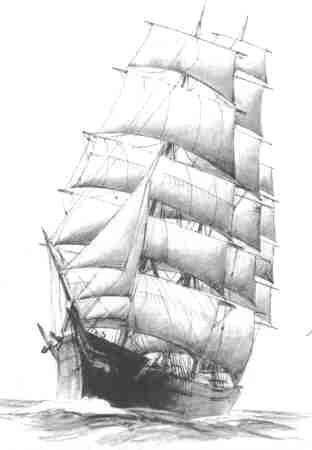
Sailing before God's Wind

"Thus saith the Lord GOD; Come from the four winds, O breath, and breathe upon these slain, that they may live." Ezekiel 37:9 (King James Version)

Fruitful Christians are like sails. They catch the Holy Spirit’s energy—the equivalent of the wind—and contribute their own strength, albeit the strength God gives them, to convey that energy to the benefit of others.

God asks them to do so in different ways. Some are called to move heavy loads, like the sails on an old time sailing ship. Others are tasked to power smaller crafts. But regardless of the size of the load their mission is the same: to use God’s power to move things in the direction He desires.

God also calls us to perform that task in different circumstances. Some of us are called to operate on relatively smooth waters, while others must do their work on rough seas.

Finally, the intensity of that work varies over time. Sometimes God really pushes us, asking us to deal with heavy winds. Other times he only sends light wind, probably because He knows that we need the respite.

(Another sailing image can be found at: Sailing Before God's Wind: John 3:8 )

Sunday, October 01, 2006

Extravagant Grace

Several weeks ago I was swimming laps late in a sunny afternoon and noticed the beautiful lines the sun made on the pool’s bottom. It struck me that they are a manifestation of God’s extravagant grace: He set up a natural system that resulted in wonderful beauty, apparently just on the off chance that someone would see and appreciate it.

Wednesday, August 23, 2006

Yoked

“Shoulder my yoke and learn from me….”
Matthew 11:29 (New Jerusalem Bible)

A yoke directs an ox’s energy towards an externally identified task, joining its effort to its driver’s direction. The ox contributes the strength; the driver directs that strength to a particular purpose and together they accomplish more than either could on their own.

By asking us to shoulder His yoke, Jesus is asking us to contribute our energy to His purposes. We aren’t simply being asked just to submit to God’s control (although that is an essential part of it), but also to actively work towards, expend our effort on, whatever tasks God has for us. Jesus teaches more than passive submission; He exhorts us to affirmative effort directed at the specific tasks He chooses for each of us.

That has wonderful results. By actively combining our effort with God’s control we achieve much more than we ever could on our own. And although the Kingdom will go forward with or without our effort, it is further ahead because of our own contributions.

Jesus not only taught that dynamic, he modeled it. His total submission to the Father’s will involved strenuous effort on his part. Rather than being a passive expositor, waiting for people to come to Him, He walked miles and miles to spread the gospel, and endured the press of many crowds. And that effort was all expended in accordance with God’s direction; Jesus actively diverted from His immediate plans went to meet folks where they were, and ultimately had to make that hard climb to Jerusalem and Golgotha, all in accordance with the Father’s plan. The result was far more than one man could accomplish on his own, but it could not have occurred without that man’s active contribution.

If we “learn from [Him],” we’ll contribute our effort to what He’s called us to, whatever that may be, and if we are faithful to His direction, we'll see results far beyond our own capabilities.

Sunday, April 30, 2006

Night Vision Goggles

We’ve all seem images captured through night vision goggles. They magnify ordinarily unperceivable light to show the wearer things that exist in the darkness. Christians are like persons given night vision goggles.

Like people walking at night, Christians must make their way through a world that appears dark, but that actually has some of God’s light present at all times and in all places. We can’t always see that light on our own and if we try to deal with things purely in our own strength, we sometimes stumble, disoriented and discouraged. But like night vision goggles, the Holy Spirit gives us the ability to perceive God’s light in a situation, allowing us to better deal with it.

There is another other parallel. Night vision goggles only help if they are put on, requiring the wearer to make the effort to avail himself of their benefits. Likewise, we only benefit from the Spirit’s guidance if we seek His help. He doesn’t impose His self on us; we have to be open to/seek out His help. Like someone who won't use the goggles offered him, we stay in the dark if we try to make it through on our own.


(Images about God providing things we need, but can’t provide for ourselves, were posted September 12a, 17a, and 18c, October 3a, 3b November 6, 10, 21 and 27, 2004 and January 2, 10b, and 10c, June 13 and 27, 2005.
Images about trusting God amidst the unexpected/difficult/incomprehensible were posted November 7, and 15, 2004, and April 25, July 11b, and August 9, 2005.)

Sunday, March 26, 2006

Gardening for God: Pornography is Like an Invasive Plant

Most experienced gardeners have had to deal with invasive plants at one time or another. They're not usually recognized as a problem at first; to the contrary, they may initially appear to be beneficial. But soon they start to spread, crowding out other, indisputably fruitful, plants. And not only do they cause the loss of the good plants’ productivity, they also deplete the nutrients of the underlying soil.

Many Christian men have had similar experiences with pornography. It too looks good at first, seeming to add a little spice to life. But it rarely stays under control. Instead, it consumes energy and attention that should be used for productive purposes and depletes our spiritual strength.

That is not a recent phenomenon; scripture confirms that lust—the power behind pornography—has always had those effects. The book of Proverbs, written thousands of years ago, attests that illicit sexual matters initially appear attractive, Proverbs 5:3, 7:16-18, but eventually get beyond our control. Proverbs 6:27-29. It also describes how, left unchecked, they consume us, Proverbs 5:9-11, with tragic results. Proverbs 5:4-5; 7:21-23. Jesus confirmed those dynamics, Matthew 5:28-30. The delivery system has changed, but the stuff being delivered is still the same.

So what do we do about it?

Experienced gardeners know that there are two primary countermeasures to invasive plants. The first is to seal their gardens off; they are careful to prevent those plants from getting into their gardens in the first place, and failing that, to completely weed them out as soon as they appear. Half way measures don’t work; if the plants are present in any quantity the gardener must spend time and effort on containment that is needed to nurture other plants and will likely fail no matter how hard he tries. The second is to make the legitimate crops as strong as possible so they are more resistant to those invasive plants that appear in spite of his best efforts to keep them out.

Scripture and experience confirm that the same is true with regard to pornography. The best approach is to avoid it altogether, to stay away from areas, virtual or otherwise, where tempting materials are likely to be found, Proverbs 5:8, 7:24-25, c.f. Proverbs 7:7-8, and to completely eliminate them if they are present. Matthew 5:29-30. And like a gardener tending to his bona fide crops, scripture instructs us to strengthen legitimate outlets for our energies so we can better deal with those instances where sexual temptation enters our lives, as it inevitably will in spite of our best efforts. Proverbs 5:18-23, 7:1-5. See also Matthew 5:31-32.


(Images about the benefits of eliminating things that distract us from God/His purposes for us were posted September 18d, October 3a and 14, November 21, December 8, 2004 and February 28 and August 3, 2005.
Other images based on gardening themes are collected at Gardening For God.)

Sunday, March 19, 2006

Savoring God's Grace In The Midst Of The Mundane

The other morning I was waiting for the bus and, between passing cars, heard birds singing. There was nothing unique about their songs, but they provided a taste of nature in a quasi-urban environment and considerably improved my mood. That was something hadn’t happened before, even though I’ve waited at that stop hundreds of times and birds had doubtless been singing during some of those waits.

But I did hear it then and the more I focused on them the more interesting they became, converting the otherwise empty wait into a pleasant experience. Perhaps more importantly, it put me in a good mood that lasted throughout the morning. You might call it a “two for.”

That taught me something about God’s grace. It’s present in the midst of the mundane, but most of the time we’re oblivious to it and hence miss its full benefits. However, if we make an effort to savor those aspects we do notice, however small they are, we are blessed not only by those particular things, but in other ways as well.


(Other images about savoring God’s blessings were posted May 16 and 20, July 7, and 15, 2005.)

Gardening For God: Cutting Back the Grasses

This is the time of year when ornamental grasses have be cut back; last year’s foliage must make way for this year’s growth. That requires removal of the fruits of a year’s efforts, as satisfying as they may be, and that the plants be reduced to stubs. Things look a bare, but there’s no other way; it has to happen if the grasses are to provide the shade and privacy expected during the coming seasons.

Jesus addressed that dynamic—that we must give up what we have to get the best God has to offer—several times during his earthly ministry. In the course of commissioning the apostles, effectively calling them to abandon their prior lives, He told them that “those who lose their life for my sake will find it.” Matthew 10:39. He later taught the same truth, when, shortly after He first revealed His coming passion, He said that “those who want to save their life will lose it.” Luke 9:24, Mark 8:35. John’s gospel also records Jesus, in describing His own death, saying that “unless a grain of wheat falls to the earth and dies, it remains just a single grain; but if it dies, it bears much fruit.” John 12:24. Bringing the matter into sharper focus for purposes of this post, Jesus’ taught in the parable of the vine that deadwood must be trimmed from fruitful plants if they are to “bear more fruit.” John 15:2.

We see the same thing in our lives. We spend a lot of time and effort on something, and it’s pretty good, but we have to let it go to produce other things God wants from us. It usually doesn’t seem like a good trade at first, but it always ends up being worthwhile if we submit to God’s will. We simply have to make that change if we are to be as fruitful as God wants us to be.

Let me give you an example. My wife and I had been married for 15 years and had a very comfortable life; we both had good jobs and, with no kids, time to enjoy the income that came with them. But God had different plans: He wanted us to adopt a child.

I was resistant, to say the least. Why should I give up my “good life” for one that would require us to, by the world’s standard, reduce our standard of living and give up any semblence of free time? It seemed like the epitome of a bad deal.

You can’t win an argument with God, so I gave in and am I ever glad I did. Our daughter brings joy—both to us and others—that we could never have imagined. Our marriage is more rewarding than it ever was before and we have experienced blessings that we could not have conceived of. It was the hardest thing I’ve ever done, and it took some time to see those rewards, but they came and have exponentially exceeded that difficulty.

But none if that would have happened if I hadn’t been willing to let go of my old life. Just like the my grasses, it had to be cut back to make room for new growth. Looking back, I now realize that if I hadn’t given it up, my old life life would have ended up like grasses that aren’t cut back: with no potential for growth and with what was already there becoming increasingly tatered and decreasingly satisfying. God had a much better idea for my life and I’m glad He cut me back so I could receive it.


(Other images about conforming/yielding to God were posted at on September 12a, 18a, 18b, 18d, and 23; October 3 and 3a, November 6; and 21, December 8, 12, and 15, 2004 and January 10d, February 18, May 11, June 18 and 27; August 21 and 27; and October 3, 2005.
Other images about the process of growing/maturing in our walk with God were posted on October 3a and 17, 2004; May 11, June 11 and 18; July 20, August 21 and 27; and October 3 2005.
Other images about trusting God amidst the unexpected/difficult/incomprehensible were posted on November 7, and 15, 2004, and April 25, July 11b, and August 9, 2005.

Other images about the lessons we can learn from parenthood are posted at What We Can Learn About God From Being Parents.
Other images based on gardening themes are collected at Gardening For God.)